The Customer Never Wanted a Faster Horse: Why understanding what matters to your customer may be more important than improving what you sell.
There is a famous quote often attributed to Henry Ford: “If I had asked people what they wanted, they would have said faster horses.” But there is little evidence Ford actually said it. But that doesn't make the idea any less useful. Because imagine for a moment that it's 1905 and you sell horses for transportation. You're standing in front of one of your best customers and you ask: “What do you want?” They might say:
· A faster horse.
· A stronger horse.
· A horse that can travel farther.
· A horse that's easier to care for.
· A horse that doesn't get sick as often.
· Maybe even a more beautiful horse.
And if you're a really good horse salesman, you listen. You go back and try to find better horses.
· You breed faster horses.
· You improve their diet.
· You develop better saddles.
· You improve your stables.
· You become exceptionally good at breeding, training, feeding, caring for and selling horses.
And then somebody drives by in a car.
What Just Happened?
The mistake would be concluding that the customer wanted a horse. But maybe they didn't. Maybe the horse was simply the best available solution for delivering something they actually valued at that time, “transportation”.
And when they looked at the alternatives they compared:
· Speed.
· Reliability.
· Convenience.
· Range.
· Comfort.
· Safety.
· Status.
· Cost.
Those are very different things than needing a horse.
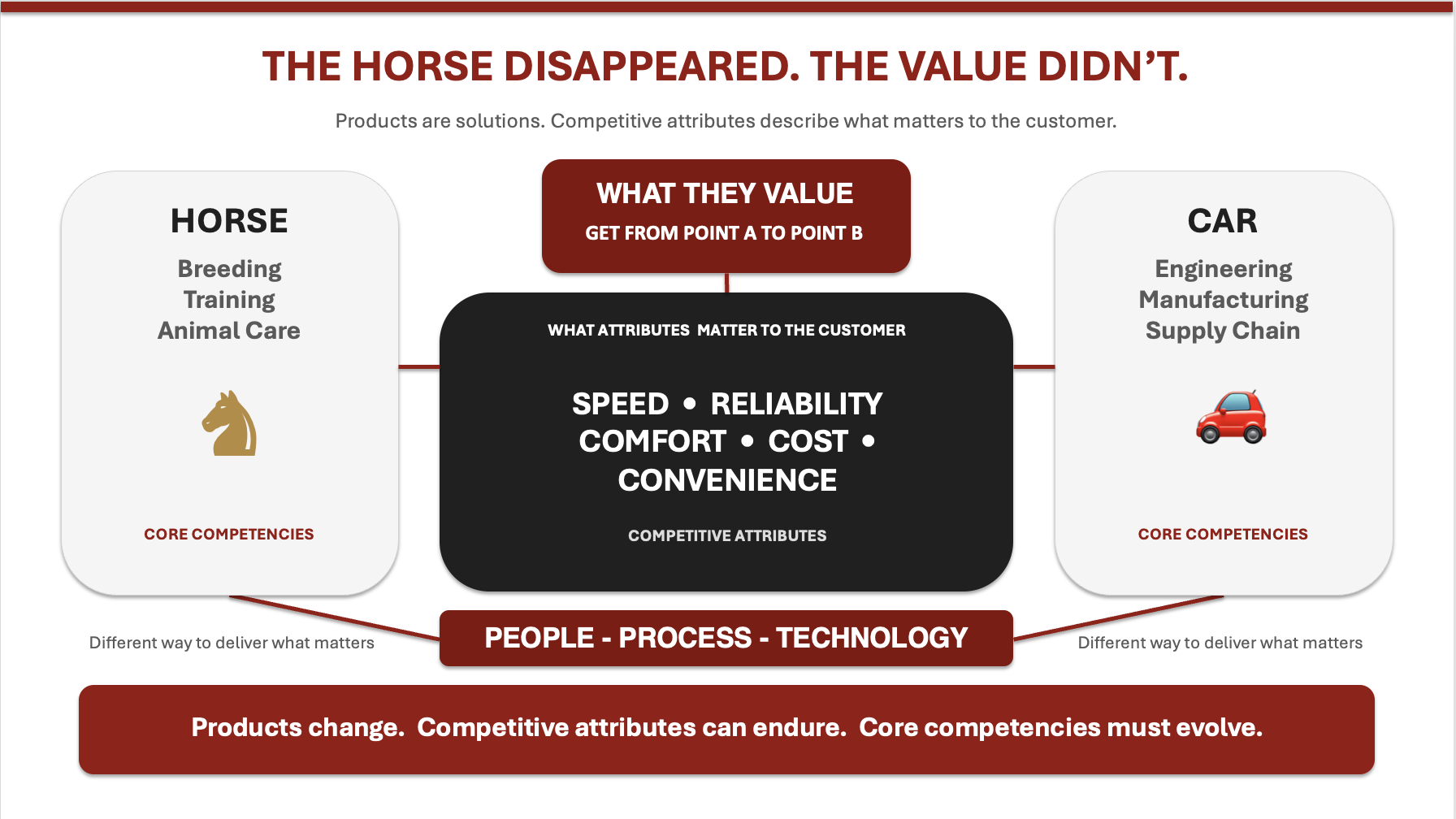
The horse was the “product” - the available solution. What the customer ultimately wanted was transportation to get themselves or something else from Point A to Point B.
And when choosing how to do that, they cared about things like speed, reliability, convenience, range, comfort, safety and cost. Those are the “competitive attributes,” the things that matter when the customer compares one solution against the alternatives. And that's an incredibly important distinction.
Competitive Attributes Are About the Customer
When I teach competitive attributes, I sometimes see entrepreneurs immediately start describing their product.
“We use higher-quality materials.”
“Our software is easier to use.”
“We have 24-hour service.”
“We've been doing this for 30 years.”
“We manufacture everything ourselves.”
Maybe those things matter. But that's not the first question. The first question is - “When your target customer chooses between you and the alternatives, what attributes are most important to them?”
Think about our horse buyer who is buying a horse for transportation. Maybe their five most important attributes are:
Speed • Reliability • Comfort • Cost • Convenience
Now imagine putting two columns on a piece of paper.
Horses. Automobiles
Speed Speed
Reliability Reliability
Comfort Comfort
Cost. Cost
Convenience Convenience
Right there that's the insight. The solution changed, but the competitive attributes didn't necessarily change with it.
The automobile didn't have to convince people to value transportation. It found a fundamentally different way of delivering the value people already wanted. The competitive attributes could remain the same but delivering them required an entirely different set of core competencies.
When I work with entrepreneurs, they often tell me about the features they believe make their product superior or special. And sometimes they become deeply attached to those features even when those things have very little to do with the attributes their target customer actually cares about when making a decision.
Different isn't necessarily better. Better isn't necessarily important. Unique isn't necessarily a competitive advantage. A difference only becomes strategically meaningful when it matters to the customer.
This is where entrepreneurs can get themselves into trouble. We can become so convinced that the customer should appreciate what makes our product special that we almost begin to hold them in contempt when they don't, sometimes verbally complaining, “They just don't understand how much better this is. They don't understand the quality. They don't understand the technology. They don't understand what went into making it”.
Maybe they don't. Or maybe we're asking them to care about something that simply doesn’t matter to them, or doesn’t matter to them yet. That's why competitive attributes have to begin with the customer, not the product. The question isn't, “What makes us special?” The question is, “What matters most to our target customer when they choose between us and the alternatives?”
Only then should we ask, “How can we become remarkably good at delivering those things?” And I think that last distinction is important…
“What makes us special?” is a product-centered question.
“What matters to the customer?” is a market-centered question.
The horse breeder could have produced the finest horse ever bred and been completely correct about its superiority and still lost the customer. Because the customer was no longer comparing horse to horse, they were comparing different ways of getting from point A to point B.
And Then Comes Core Competency
This is where another distinction becomes important. A “competitive attribute” is something the customer considers when comparing alternatives to solve a problem or achieve something they value. A “core competency” is something the company must be exceptionally good at to deliver on those attributes and help the customer realize that value.
Go back to our horse business. If speed is an important competitive attribute, the horse company might need to become exceptionally good at selective breeding, training, nutrition and animal conditioning. If reliability is an important competitive attribute, the company might need exceptional veterinary knowledge, animal care and stable management.
Those capabilities can potentially become core competencies because they are things the company must do exceptionally well internally to consistently deliver on the competitive attributes customers use to evaluate the alternatives.
Now consider the automobile company. The customer may still be trying to achieve the same underlying value - getting from Point A to Point B - and may still evaluate the alternatives using many of the same competitive attributes: Speed. Reliability. Comfort. Cost. Convenience.
But the core competencies required to deliver on those attributes have completely changed. Instead of breeding and animal husbandry, the automobile company might need to be exceptional at:
· Mechanical engineering.
· Manufacturing.
· Engine design.
· Supply-chain management.
· Assembly.
· Quality control.
The “competitive attributes” can remain the same while the “core competencies” required to deliver them changes completely. And that is a big deal.
People, Process, & Technology
The customer may tell us that when choosing between alternatives, things like speed, price, reliability, or ease of doing business really matter. Those are the competitive attributes.
So the company asks, “What must we be exceptionally good at to perform on those attributes better than the alternatives?” That's where we begin discovering our core competencies.
And then we go another level deeper: “What people, processes and technology make us capable of doing those things consistently?”
So the chain becomes:
1. CUSTOMER VALUE
What are they ultimately trying to accomplish?
2. COMPETITIVE ATTRIBUTES
What matters when they compare different ways of accomplishing it?
3. CORE COMPETENCIES
What must we be exceptionally good at to perform on those attributes better than the alternatives?
4. PEOPLE • PROCESS • TECHNOLOGY
What makes those competencies possible and repeatable?
People, process and technology aren't the core competencies themselves. They are the infrastructure that allows the company to build, sustain and repeatedly execute those competencies.
That's very different from simply listing things your company does well.
The Dangerous Question: “How Do We Build a Better Horse?”
And this isn't just a marketing distinction. It changes how you think about strategy. If I'm convinced that my business is horses, then my strategic questions probably sound like:
· How do we breed a faster horse?
· How do we make horses healthier?
· How do we lower the cost of feeding horses?
· How do we build better stables?
· How do we sell more horses?
Those might all be excellent questions. Right up until the automobile drives by because I've defined my business by the “solution” rather than by the “problem it solves” or the “value” being created.
There's another question I could have been asking: “What is my customer really trying to accomplish with the horse, what matters most to them when choosing how to do it, and is there a fundamentally better way to deliver that value?”
Now I'm thinking very differently. I'm no longer defending the horse. I'm studying the customer.
So What Finally Killed the Horse?
The automobile didn't replace the horse simply because someone invented a car. In fact, early automobiles were worse than horses in plenty of ways. They were expensive, unreliable, unfamiliar and had very little infrastructure supporting them.
The change happened as automobile companies became increasingly capable of delivering the attributes that already mattered, speed, reliability, convenience, comfort and cost, better than the horse could.
And they didn't have to win every attribute at once. They had to become sufficiently better on enough of the attributes that mattered that customers were willing to tolerate the places where the automobile was still worse.
That may be the tipping point in any disruption - The customer changes solutions when the total value of the new solution becomes meaningfully better than the total value of the old one.
But something else happens along the way. New products don't just compete for existing customer preferences. Sometimes they change what customers believe is possible. Once I experience the ability to leave when I want, travel farther, move faster and do it without feeding and caring for an animal every day, those attributes may become more important to me than they were before and the solution begins changing the customer's expectations.
And that raises another strategic question, “Are we only getting better at what matters to customers today, or are we paying attention to new solutions that could change what matters to them tomorrow?” Because eventually the horse breeder wasn't competing against a better horse he was competing against a new definition of transportation.
This Matters Even More Right Now
AI, automation, robotics and new business models make this more than an interesting story about horses and automobiles. Somewhere right now, companies are finding fundamentally different ways to deliver on attributes that already matter to your customers - speed, cost, convenience, quality, customization, reliability - in ways that weren't previously possible. And just like the automobile, some of those technologies may eventually change what your customers expect altogether.
That's why understanding your competitive attributes matters so much. If you only understand your product, disruption looks like a threat. If you understand what your customer is ultimately trying to accomplish and what matters most to them when choosing how to accomplish it, disruption may reveal an entirely new way to deliver that value.
Competitive attributes can endure as solutions change, but they aren't permanent. New solutions can change which attributes matter most and can even introduce attributes customers never knew were possible. The car first competed on attributes people already cared about. Then the car changed what people expected transportation to be.
Ask Yourself a Different Question
Here is a great set of questions to help you. First, try to avoid the question, “How do we make our product better?” That question is a “product mindset” and we want to be in the “strategic mindset”. So start with…
1. “What does our target customer actually value?”
2. “When choosing between us and the alternatives what attributes matter most to them?”
3. “What must we be exceptionally good at to deliver those attributes better than anyone else?”
4. “What people, processes and technology make us capable of doing that consistently?”
5. “If our customers could no longer buy the product we sell today, what would they still be trying to accomplish and what would they still value?”
Because the horse may disappear but the need to get somewhere doesn't.